Date: 08/10/2026
Authors: Sadie Rockliffe, University of Brighton; Clare Phillips, University of Southampton; and Clara Girault, University of Southampton
Bios:
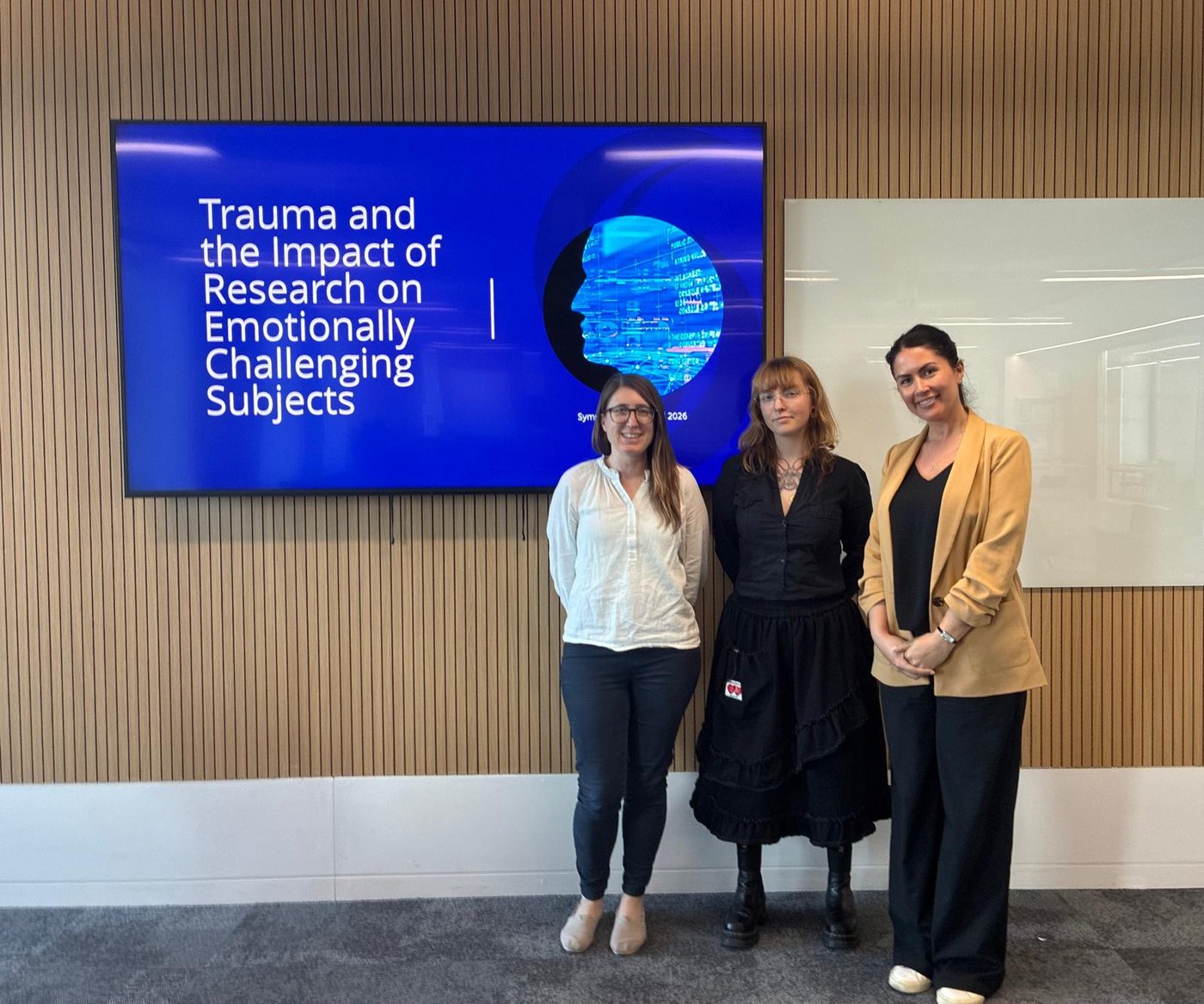 Sadie Rockliffe is a third-year SCDTP PhD candidate at the University of Brighton, working within social justice, critical disability studies, and postqualitative inquiry.
Clare Phillips is an alcohol nurse specialist and SCDTP candidate in Social Statistics and Demography at the University of Southampton.
Clara Girault is a third-year PhD student at the University of Southampton in Social Statistics and Demography, funded by the South Coast Doctoral Training Partnership. Her research focuses on the estimation of hidden suicide in high income countries.
In 2025, the Trauma-Informed Research Special Interest Group (TiR SIG) was established within the South Coast Doctoral Training Partnership (SCDTP) by Sadie Rockliffe, a PhD candidate at the University of Brighton researching disability, blue space access and environmental justice, and Clare Phillips, a PhD candidate in Social Statistics and Demography at the University of Southampton. The group brings together researchers interested in trauma-informed research, vicarious trauma, and the emotional and ethical demands that can accompany research on sensitive subjects.
Around the middle of the same year, Clara Girault, also a PhD candidate in Social Statistics and Demography at the University of Southampton, completed her second progression review, which prompted further discussion about the emotional demands of being a quantitative researcher working on challenging topics, how to manage those aspects of research, and the kinds of training available to researchers undertaking this work. Attempts to identify appropriate training highlighted how difficult it could be to find support that addressed these issues directly, particularly for researchers working exclusively with quantitative methods. This led to conversations within the TiR SIG, with other postgraduate researchers, departmental colleagues and senior staff, as well as with researchers encountered through external workshops and conferences.
These conversations showed that the issue resonated well beyond our immediate research contexts.
From these conversations, the three of us developed a shared aim: to create a workshop or symposium specifically for mixed-methods and quantitatively focused researchers working with sensitive or emotionally challenging data at different stages of their academic careers.
The level of interest that followed indicated substantial demand for more sustained discussion about researcher wellbeing, exposure to distressing research material and institutional responsibility within quantitative research contexts.
Why quantitative research?
Within qualitative research, discussions of vicarious trauma, emotional labour and researcher vulnerability are increasingly common, alongside important ethical consideration of both participant and researcher wellbeing. However, considerably less space has been given to asking how researchers working with quantitative and secondary data may also be affected by the emotionally challenging subjects they study.
Whilst the distinction matters, it should not become a division between methodological traditions. One of our aims was therefore to bring insights and learning already developed within qualitative research into conversation with quantitative research practice, while considering the particular circumstances in which quantitative researchers working with secondary data encounter emotionally demanding material.
Researchers may spend prolonged periods working with data concerning violence, abuse, suicide, trauma, conflict and inequality. Emotional proximity to these subjects does not disappear because the material is encountered through datasets, case files, surveys or statistical models. Repeated engagement with distressing material can carry emotional and ethical weight even where the researcher has no direct contact with participants.
Our aim was therefore to create a supportive space in which researchers could discuss both researcher wellbeing and the particular experience of undertaking quantitative research on emotionally challenging subjects. We wanted to increase awareness of emotional labour and researcher vulnerability while also recognising that vulnerability, access to support and institutional power are unevenly distributed across career stages.
A master’s student or doctoral researcher, for example, may have substantially different support needs and levels of institutional power from a principal investigator, supervisor or senior member of staff. Effective responses therefore cannot assume that all researchers experience risk, responsibility or access to support in the same way.
The symposium
These discussions led to the development of Trauma and the Impact of Research on Emotionally Challenging Subjects: Identifying and Addressing Quantitative Researchers’ Needs, held at the University of Southampton on 17 April 2026.
The level of engagement exceeded our expectations. The symposium sold out within 48 hours, and additional tickets were subsequently released in response to demand.
The programme brought together speakers from different academic and professional backgrounds. It included keynote contributions, a panel discussion chaired by Professor Athina Vlachantoni, Director of the South Coast Doctoral Training Partnership, a contribution from Katie Coultas from University of Southampton Staff Wellbeing, and opportunities for both structured discussion and informal reflection.
The panel brought together SCDTP doctoral researchers, early career researchers and supervisors. This enabled discussion across academic roles and career stages about how emotionally challenging research is experienced and what forms of support may be needed.
We were also fortunate to be joined by Dr Tina Skinner from the University of Bath‘s Researcher Wellbeing Project, Professor Karen Devries and Dr Nambusi Kyegombe from the London School of Hygiene and Tropical Medicine. They shared research, expertise and experience of working within emotionally demanding research contexts.
More broadly, the symposium brought together master’s students, doctoral researchers, early career researchers, established academics, practitioners and institutional wellbeing professionals from across disciplines and institutions.
What we heard
One of the clearest messages from the day was that researcher wellbeing in emotionally challenging quantitative research was not simply an interesting methodological issue. For many attendees, it was a conversation that had been largely absent from their previous research training and professional environments.
Feedback from participants made this particularly visible.
One attendee explained that the symposium had prompted them to reconsider the support provided to a researcher working with highly distressing sensitive data. Following the event, they contacted the researcher and relevant supervisor to discuss appropriate wellbeing and safety planning.
Another attendee reflected:
“The symposium helped me realise that I am not alone in this field.”
Others described the event as:
“Meaningful, well organised, and much needed.”
And:
“Brilliant to discuss what for me has been something we have (accidentally) ignored professionally so far.”
What happens next
The response has continued beyond the symposium itself. We have received requests to establish an ongoing network or community of practice through which researchers could share resources, discuss challenges and connect with colleagues across institutions and disciplines.
Participants have also suggested developing a broader hub that could signpost researchers towards existing initiatives and regional networks. Such an approach could strengthen connections between work already taking place nationally rather than reproducing existing resources.
There have also been requests for the symposium to become an annual event, alongside early discussions about future collaborations and possible publication outputs.
What began as a series of conversations between a small group of researchers has therefore developed into a wider discussion about how universities understand and respond to the emotional demands of research.
The challenge now is not simply to recognise that emotionally challenging research can affect researchers. It is to consider what forms of preparation, supervision, peer support and institutional responsibility are needed across methodological traditions and career stages, and how those forms of support can become part of ordinary research practice rather than something researchers have to seek only after difficulties arise.
Acknowledgements
We’re also incredibly grateful to the Faculty of Social Sciences at the University of Southampton and the South Coast Doctoral Training Partnership (SCDTP) for supporting the event and helping to make the symposium possible.