What does the South Coast Doctoral Training Partnership do?
Funded by the Economic and Social Research Council (ESRC), the South Coast DTP (SCDTP) funds and supports 30+ PhD students per year to train as social science researchers. SCDTP students study at one of our four partner institutions:
- University of Southampton
- University of Brighton
- University of Chichester
- University of Portsmouth
The SCDTP delivers cutting-edge, flexible, student-centred postgraduate training to produce highly qualified and rounded social scientists, equipped to meet contemporary economic and social challenges.
As part of the SCDTP training offering, students do a 3-month (or part time equivalent) placement to practice and develop their skills in a work environment.
How could your organisation benefit from having a SCDTP student on placement?
Skilled resources to focus on a project:
 Having an SCDTP student means you get a highly skilled, dedicated resource to work on a specific project for up to 3 months (or part time equivalent).
“Hosting an SCDTP student in our team has been a great way to inject a new perspective to our work. It has been immensely valuable to host such a knowledgeable colleague, primed to act as a critical friend while also providing practical support for our projects. I would highly recommend it to any organisation considering it”
Eden Munro, Hackney Council
Access to a broad range of research skills:
Our SCDTP students are supervised by leading academics in their field meaning your organisation can benefit from subject or methodological expertise applied to your project. This creates a positive knowledge exchange benefiting both the student and your organisation.
“Our experience of the SCDTP placement, in a Local Authority Public Health team, was very valuable. The student we hosted was highly skilled and had research experience and publications in the area they were supporting our learning on, meaning that they could deliver the project independently and competently. Hosting them has been a great experience, and we would definitely consider accepting a further SCDTP student in the future.”
Dr Gail Mann, Portsmouth City Council
Access to the future talent pool:
Having a SCDTP student to work on your project means you open up your networks to future talent broadening your organisation succession planning opportunities.
What can a placement offer to your organisation?
- Evaluation of projects and policies
- Evidence-based decision-making
- Advanced quantitative or qualitative techniques
- Impact assessment
- Stakeholder mapping
- Bridging research-practice gaps and much, much more….
How to reach out to SCDTP students about your placement opportunity
There are a variety of ways to engage with SCDTP students in addition to advertising placement opportunities.
The Research in Practice Team host an event each year to provide opportunities for students to meet placement hosts, alumni and peers. The Your Placement Journey: Meet Hosts, Alumni & Peers events are typically hosted in Jan|Feb and allow placement host organisations to meet SCDTP students, present their placement opportunities, answer questions and get a better understanding of the skills SCDTP students can bring to your organisation.
The Research in Practice team can also work with you to create an online event and send out invitations and meeting links to the appropriate student groups.
If you would like to explore either of these opportunities, please contact the Research in Practice team using scdtp@soton.ac.uk.
There is also the option on your placement advert to offer to speak to students before they apply so they can discuss the opportunity with you in more detail.
5 Steps to become a South Coast Doctoral Training Partnership placement host
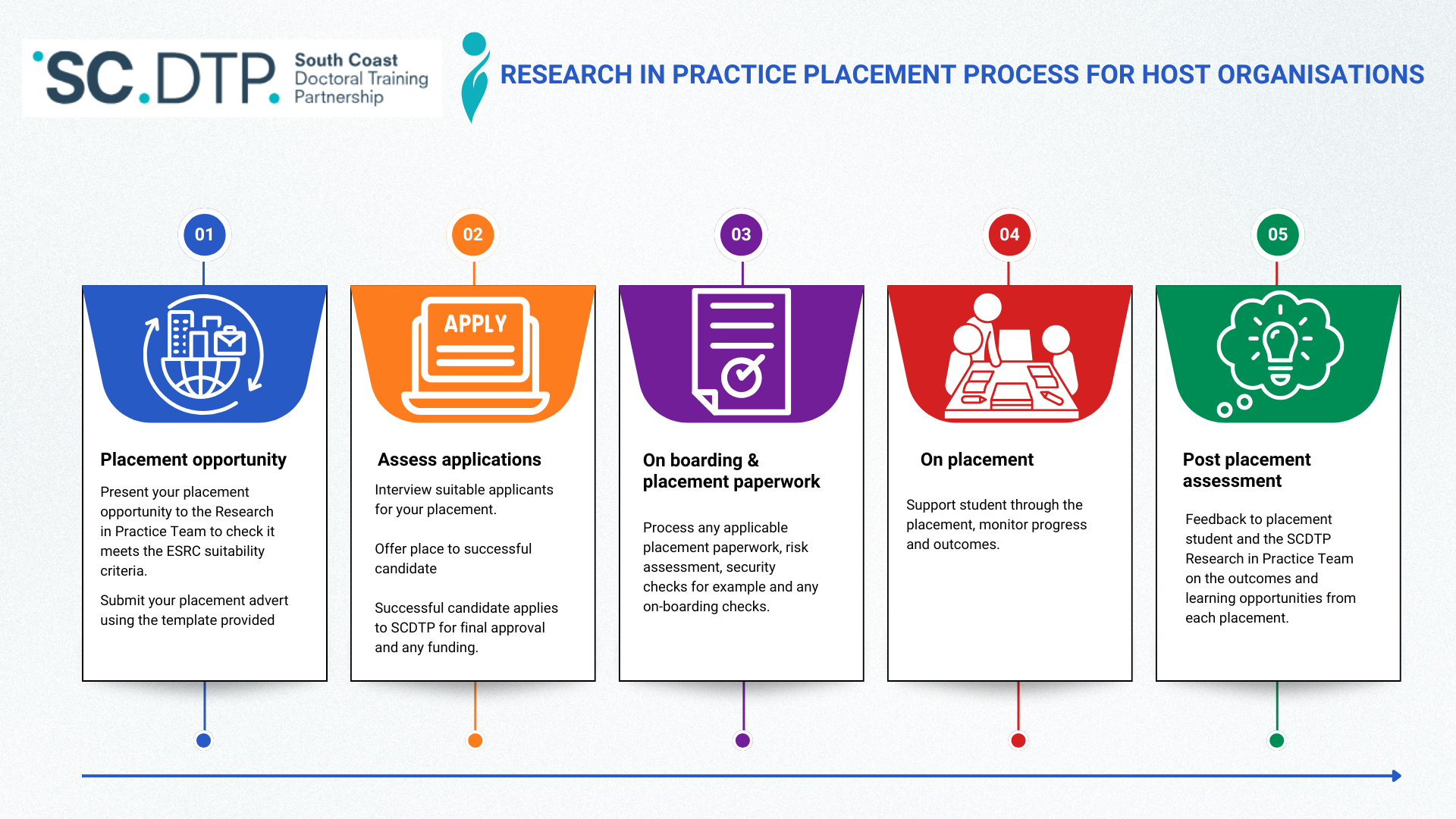
Step 1 Expression of interest
Complete the Expression of Interest form.
This form gives us the basic information about your organisation and an overview of your placement offering, timelines and contact details. It allows the Research in Practice Team to assess the suitability of your placement offer.
Step 2 Advertise and recruit
Once approved as a host, you can use the Research in Practice Placement Advert Template to create an advert for your placement opportunity. The template includes guidance to help you create excitement around your project and appeal to students, as well as what to include to ensure your advert contains all the important details of your placement offer.
We will advertise your offer and sometimes target or match potential students. From this process you may select suitable applicants and interview using your selection process, and make an offer to the successful candidate.
NOTE: If a student approaches you directly about a placement and they are suitable, you do not need to advertise the placement.
Step 3 Approval
The successful candidate will need to apply to SCDTP for final approval and any funding. You will need to work with your successful candidate on the Research in Practice Placement Application Form to provide details about the project, allocated mentor, mutual benefits, financial support and available resources.
Subject to approval by the SCDTP Senior Management Team, the successful candidate can start to complete appropriate on-boarding paperwork.
Step 4 Placement support
You will support the student through the placement project and monitor progress and outcomes. Your placement student will be asked to complete an Assignment for Research in Practice Placement.
Step 5 Feedback
We welcome feedback to the placement student and the Research in Practice team on the outcomes and learning opportunities from the placement. We will contact your once the placement is complete and invite you to complete a short feedback form.

Frequently Asked Questions
Can my organisation advertise more than one placement opportunity?
Yes, you are welcome to offer any combination of opportunities from a single one-off placement to multiple placements year on year. Please note that we cannot guarantee to find you students with the skills and interests to match your needs but we will try.
What contributions does my organisation need to make to the placement?
SCDTP students continue to receive their studentship stipend throughout their Research in Practice placement. They can also apply for up to £1,000 to support reasonable travel and accommodation expenses for the duration of their placement. If a student decides to split their time across more than one placement the funding is split across all the placements.
As a placement host, if your placement requires any kind of business trip, for example if in-person interviews are required as part of the placement project, those travel and accommodation expenses would normally need to be covered by you as the placement host.
If your placement requires frequent/long distance travel to your office, then it is reasonable to expect you to cover those costs.
You can also make contributions in kind, for example if you are able to offer the placement student lunch every day. You may also have access to useful networks that hold value to the successful candidate or add value through mentoring.
Other resources your organisation can provide might be desk space, internet access, digital devices and databases.
How long can the placement be?
Each SCDTP student needs to do 3 months or part time equivalent in placement(s). A student can split that time between up to three 1-month placements.
We encourage part-time options as we have part-time students who need to be considered.
Your placement needs to fit in with a reasonable working week that does not exceed 37.5 hours per week (or part time equivalent).
Can placements be remote?
Yes, if your placement project lends itself to the successful candidate working from home or their university desk on the placement project, this is acceptable. As a placement host you do need to show you are able to support the successful candidate online.
We do encourage some in person opportunities where possible, however this is not essential.
Is it OK if a SCDTP student approaches my organisation directly with a placement proposal?
Yes, we actively encourage our students to leverage their network and negotiate a suitable placement project. If you have been approached by a SCDTP student and agree on a suitable placement project, please follow the 5 Steps to become a SCDTP placement host.
When a student approaches you directly about a placement and they are suitable, you do not need to advertise the placement.
If you would prefer to speak to the SCDTP Research in Practice team in the first instance, you are welcome to do so and can contact us at scdtp@soton.ac.uk.
Is there a difference between placements and internships?
We use the terminology “placements” or “Research in Practice Placements” so we are in line with new ESRC terminology.
Whether your organisation calls them “internships” or “placements”, if they meet the ESRC suitability guidelines, either name is OK.
What are the ESRC placement suitability guidelines?
Placements could be with academic or non-academic organisations and examples of the form these can take include:
- Placements with non-academic organisations in the public, private or voluntary sector
- Placements with a research centre
- Placement within a higher education institution’s professional support services
- Research assistant internships, where students work on standalone projects with academics from across disciplines.
A student cannot be placed with their current supervisors or research team or in their home department.
Although the skills and networks developed may be helpful for a student’s PhD as well as their future career, they cannot use the placement to generate data for their PhD or use their PhD fieldwork site as their placement.
When is the best time to approach the SCDTP Research in Practice Team about my organisation’s placement opportunities?
You can contact the team at any time about a placement opportunity or a potential placement opportunity. We can also support you with defining the details of your placement.
You need to consider the time needed to present your opportunity, for students to review it and apply, interview for the placement, and approval.
Having a degree of flexibility on start dates for your placement is helpful as your successful candidate may have PhD project commitments they need to work around.
What happens if I don’t get any applicants?
Each cohort of SCDTP students is different and you may not receive applications for your placement opportunity every time.
The SCDTP Research in Practice Team will do our best to match your placement with a suitable set of candidates. We can also present the opportunity to the wider network of 15 DTPs for consideration if we do not have a suitable student for you.
Please note that in this case we are not able to offer skills checks or support.