Date: 08/10/2026
Author: Nick Huxley, University of Brighton
Bio:
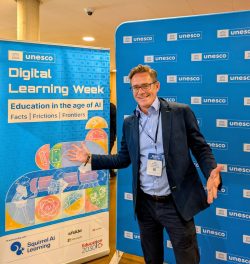 Nick Huxley is an ESRC-funded PhD researcher in the School of Education, Sport and Health Sciences at the University of Brighton, supported by the South Coast Doctoral Training Partnership. His research explores how AI-mediated tutoring shapes mathematical reasoning, dialogue and learner agency in primary education. Before beginning his PhD, Nick spent thirteen years teaching in primary schools, including ten years as a computing subject lead, following an earlier career in technology and telecommunications. He is particularly interested in how educational technologies support children to develop and explain their own ideas, and in the question of who is doing the thinking.
In September, I spent three days at UNESCO’s Digital Learning Week in Paris, an event bringing together educators, researchers, policymakers and technology developers to discuss digital technology and education across the globe. AI featured prominently, of course, with discussions ranging from what happens when a learner uses an AI tutor to how education systems should evaluate and govern these technologies.

One of the things that struck me, as an ex-primary teacher, was how familiar some of the questions sounded. When should we offer a learner help? What can we tell from a correct answer? Who decides what successful learning looks like?
These were questions I recognised from thirteen years of primary teaching, and which now sit at the centre of my PhD. My research explores how AI-mediated tutoring shapes children’s mathematical reasoning, particularly the question of who is doing the thinking when a child learns with an AI tutor.
Hearing these questions discussed alongside national policies, the design of AI systems and teachers’ professional judgement helped me think more broadly about my own work. I’m still processing several of those connections, as some sharpened questions that I already had, while others made me reconsider where my research, and my preceding career experiences, might contribute.
Pedagogical sovereignty and who defines quality
One phrase from the opening keynote really stuck with me: ‘selection is sovereignty’, as for me, this raised questions about who gets to choose an AI system, who can evaluate it, and how much local expertise exists to challenge or adapt it.
Numerous discussions of AI sovereignty and locally defined benchmarks made me think much more seriously about pedagogical sovereignty: the capacity of educators to shape the educational purposes and criteria by which these tools are judged. Should schools simply accept a technology vendor’s definition of successful learning?
This connected closely with questions in my own research about what we can realistically expect educators to know about increasingly complex AI systems. We may not be able to fully understand how an AI model has arrived at an answer, but we can aim to make the learning relationship around it more understandable. Essentially, this means giving educators opportunities to define and test the educational criteria that matter in their settings.
I found this a useful way of thinking about how schools could participate more actively in the development and evaluation of AI.
The thinking hidden behind a successful answer
Another conference platform conversation connected very closely with my own research, one that explored the ‘illusion of competence’, referring to the event when an AI-generated explanation can be fluent and convincing without necessarily meaning that we have understood it. The emphasis on learners needing to reason through a process, tolerate confusion, articulate what they understand, whilst also evaluating whether something makes sense, resonated hugely.
A distinction was made that I’m still thinking about: AI may take over aspects of the learner’s monitoring, judgement and decisions about what to do next, as well as helping with the task itself. These processes of monitoring and managing our own thinking are central to metacognition.
This matters because cognitive offloading, where we use something external to take on part of the mental work, does not necessarily look like inactivity. A learner can be busy and apparently successful while the AI takes responsibility for choosing the strategy, directing the next steps, or checking progress.
If observing a learner’s experience, and what appears to be fluent participation and correct answers look like understanding, an AI-mediated interaction may have created such an ‘illusion of competence’.
For my own research, this sharpened the importance of examining who chooses the next step within an AI and learner conversation, who checks it, who recognises uncertainty, and who decides that the problem is resolved. It also gives me something more specific to look for when an interaction appears to be going well.
When the hard part becomes optional
Then came ‘desirable difficulties’, a term that was new to me, although the educational problem was not. Bjork and Bjork (2011) describe how some conditions that make learning feel harder can support longer-term learning. Trying to retrieve something from memory, for example, can be more demanding than immediately looking it up.
The distinction between difficulties that support learning and those that obstruct it is important. For example, confusing instructions or an inaccessible task may simply prevent a child from participating. Removing those barriers can be valuable. However, some of the ‘hard part’ is the work of generating an idea, comparing possibilities or reconsidering an explanation: ‘desirable difficulties’.
I’ve been thinking for some time about Gert Biesta’s The Beautiful Risk of Education (2013), and what can be lost when education becomes too concerned with predictability, efficiency and removing uncertainty. The learning-science discussions at UNESCO gave me another way of approaching that concern. One conference panellist asked, what happens to the thinking when the hard part becomes optional?
After hearing Vygotsky’s Zone of Proximal Development invoked several times (the idea of what a learner can do with support beyond what they can do independently, and a seminal pedagogical tenet of teacher training) I kept smiling at how many apparently new questions raised by AI turn out to be very old questions about teaching and learning. Perhaps AI is giving those questions new urgency.
Personalised for what?
‘Personalised learning’ was used throughout the conference discussions, but not always to mean the same thing. Sal Khan, founder of the educational tech company Khan Academy, described personalised learning as meeting individual needs while freeing teachers for more human interaction and small-group support. Wayne Holmes, a researcher in AI and education at UCL, challenged and suggested that personalisation has come to mean different pathways towards the same predetermined destination (i.e., the same learning objective). He also stressed that learning remains social and relational.
I found myself returning to a question from my teacher training in 2010: personalised for what?
The social nature of learning is something I want to keep in mind when examining AI-mediated tutoring. How might technology support opportunities for children to discuss and develop ideas together? And how would we recognise that contribution when evaluating it?
What are we trying to cultivate in education?
The final sessions brought these discussions back to the question of educational purpose. The idea of what education should preserve and develop was delivered with a provoking question about what forms of human discernment education now needs to cultivate.
For me, this connected with the earlier discussions about judgement and uncertainty. If AI can help us produce an answer, we still need opportunities to consider whether that answer makes sense, what assumptions it contains, and whether a different approach might be needed.
There was plenty of disagreement across the week, yet it often helped bring the underlying educational questions into focus. Hearing different perspectives together helped me think more carefully about what I am asking of these technologies, and what evidence would help us understand their educational contribution.
Three perspectives on the same problem
Perhaps the most personally important part happened between the sessions, where conversations made me see my rather unusual route into the PhD differently. I spent my first career working both commercially and technically with internet and telecommunications technology in the dotcom era of the late 1990s/ early 2000s, then thirteen years as a primary teacher, and now I’m a researcher. At times in Paris, those stopped feeling like three separate careers and started to look like three perspectives on the same problem.
That combination now feels more useful because the questions schools face involve both technology and pedagogy. They concern what these systems actually do in practice, what evidence we have for their effects on learning and reasoning, and how teacher judgement is retained.
Paris extended some of my pre-existing questions, and took them in directions I hadn’t anticipated. That feels like a very worthwhile thing to bring back into a PhD.
References
Biesta, G. J. J. (2013). The beautiful risk of education. Paradigm Publishers.
Bjork, E. L., & Bjork, R. A. (2011). Making things hard on yourself, but in a good way: Creating desirable difficulties to enhance learning. In M. A. Gernsbacher, R. W. Pew, L. M. Hough, & J. R. Pomerantz (Eds.), Psychology and the real world: Essays illustrating fundamental contributions to society (pp. 56–64). Worth Publishers.