Date: 30/06/2026
Author: Barbara Sherriff, University of Brighton
 Bio:
Bio:
Barbara Sherriff is a PhD candidate in the School of Business and Law at the University of Brighton. Her PhD is supported by the ESRC South Coast Doctoral Training Partnership (Grant No. ES/P000673/1). Her published papers include Student employment, wellbeing and employee capital and How can employers be encouraged to invest in skills training? (YEET0080) in response to the Government’s Inquiry into Youth Employment, Education and Training.
I attended a Knowledge Exchange webinar on PhD researcher placements with the government and, having read the Host Partner Information, applied for a three-month placement with the Department for Work and Pensions (DWP) in early September 2025. I knew next to nothing about the DWP’s enormous remit or how this might translate into a job, but I was drawn to its stated vision of improving people’s day-to-day lives through work and at work, making this department a natural fit for my research.
Following my application, I was lucky enough to join an SCDTP visit to Westminster organised by Dr Jane Parry, where I gained an insight into how research is used in Parliamentary Decision Making. I was also fortunate enough to be invited by Dr Anne Daguerre to a research report launch, where I met Nicholas Warrington from the DWP who appeared to be talking my language (centering employers as a solution not employees as the problem). I also met Dr Katy Jones from Manchester Metropolitan University who was so positive about her recent DWP placement investigating quality work. I had spent the last two years of my full-time PhD mostly sitting in the corner of a room reading and typing, so I was concerned about managing a new full-time role in a completely new environment, with a 3.5 hour commute to Westminster and back, working with people I knew nothing about in an unknown job. The recent interactions I had had reassured me, however, and by the time Christian Diamond offered me one of their highly competitive placements, I was happy to take a leap of faith and accept it with thanks.
All applicants are told from the start that “it is not possible to say with certainty precisely what work you will be tasked with until you arrive”, and even at the offer stage I still had no idea what was actually being offered regarding the role and responsibilities or the expectations of my knowledge, skills and experience. Luckily, my application found its way to Dr Alice Chandler, a social researcher in the Young People’s Employment Support Research team, which sits within the Labour Market Analysis Division (LMAD), part of the Labour Market Directorate Policy Group. None of this meant anything to me, but the project I would be leading did: to define quality work experience for young people aged 18-24. After completing several stages of paperwork, including the initial application, funding confirmation, right to work checks, placement outline and cost estimates, a health check, and a request to intermit, each signed off by multiple people, I started my placement more than seven months after the initial application!
Good things come to those who wait, and my experience was definitely worth that wait. The team and the department were really welcoming, whether in London, Manchester or Leeds, and people were generous with their time despite having multiple tight deadlines. My first-time line manager, Alice, made sure I was fully integrated in the department and that I was introduced across different government teams. She was fully supportive of my ideas and working in a way which suited my style. What struck me most, from the departmental leads in the central office to work coaches in the local job centre youth team, was the motivation people had to make a positive difference within an extremely complex and multi-layered reality. I was really surprised that such a massive department could be so values-led and feel so supportive, and this placement gave me a huge insight into working for the government. It also gave me a huge insight into the individual experiences of young people not in employment, education or training, and how they are supported by the government.
As part of my research placement, I observed a focus group with the jobcentre youth team staff discussing the government’s Youth Guarantee and the changes they had made locally to reduce the number of young people not in employment, education or training (NEET). I then interviewed members of this youth team in situ to explore their perceptions of work experience and the conversations they had with their young jobseekers. Finally, I interviewed seven young people who had chosen work experience as their pathway into work, using the data-rich transcripts as the basis of my findings. The biggest surprise was the range of motivations young people had for choosing work experience, not shaped by education but by personal situations. These included wanting to develop transferable skills to bolster a CV, using it to reconnect with society after being in an isolated ‘negative spiral’, or to build personal confidence to feel more comfortable in a professional space. Despite different circumstances, different placements (cafe, warehouse, office and even the job centre itself) and different education levels (degree, A levels, GCSEs and no qualifications) there were a surprising number of similarities. Work experience wasn’t seen as transformational, but young people did describe multiple positive outcomes which could act as a stepping stone into or towards work, most commonly including confidence building.
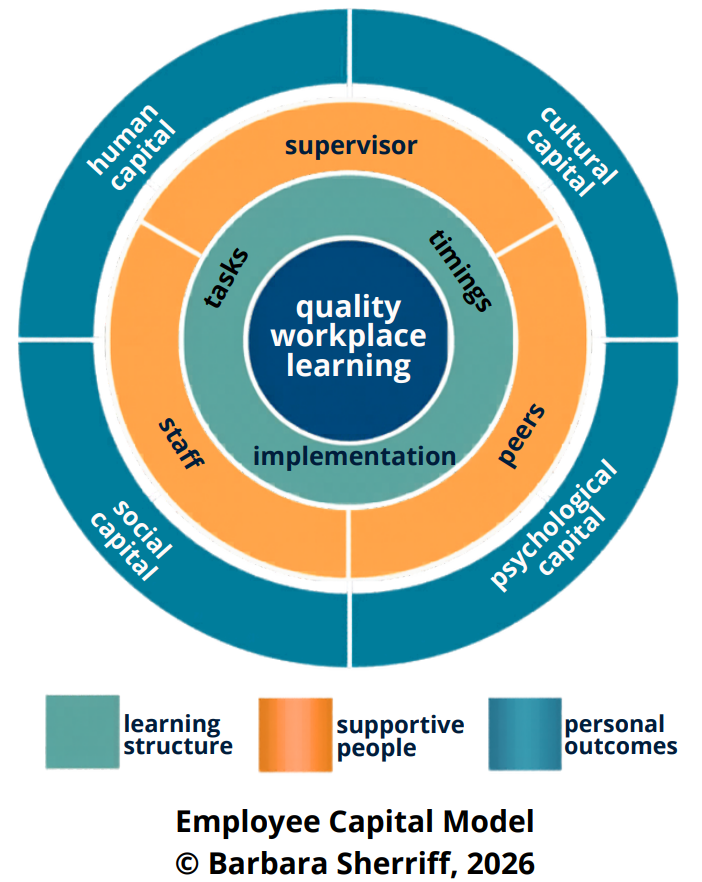
This placement provided me with many things for which I’m incredibly grateful, including the reassurance that my PhD has real-world value for policymakers. There really is nothing so practical as a good theory, and my Employee Capital Model proved to be a highly relevant conceptual framework for understanding quality work experience. Based on the article Student employment, wellbeing and employee capital, this model maintains that structured and supported entry-level workplace experiences can help young people develop employee capital – those personal resources (including self-confidence) which support wellbeing, work-readiness and employability. Entry-level work and work experience might not feel transformational to those working in routine, repetitive work, but these experiences should be assessed by their outcomes. Where structures meet individual needs, and tailored support is provided, work experience can be a valuable ‘stepping stone’ to take someone closer to paid work or into a chosen career, depending on where they are on their pathway.
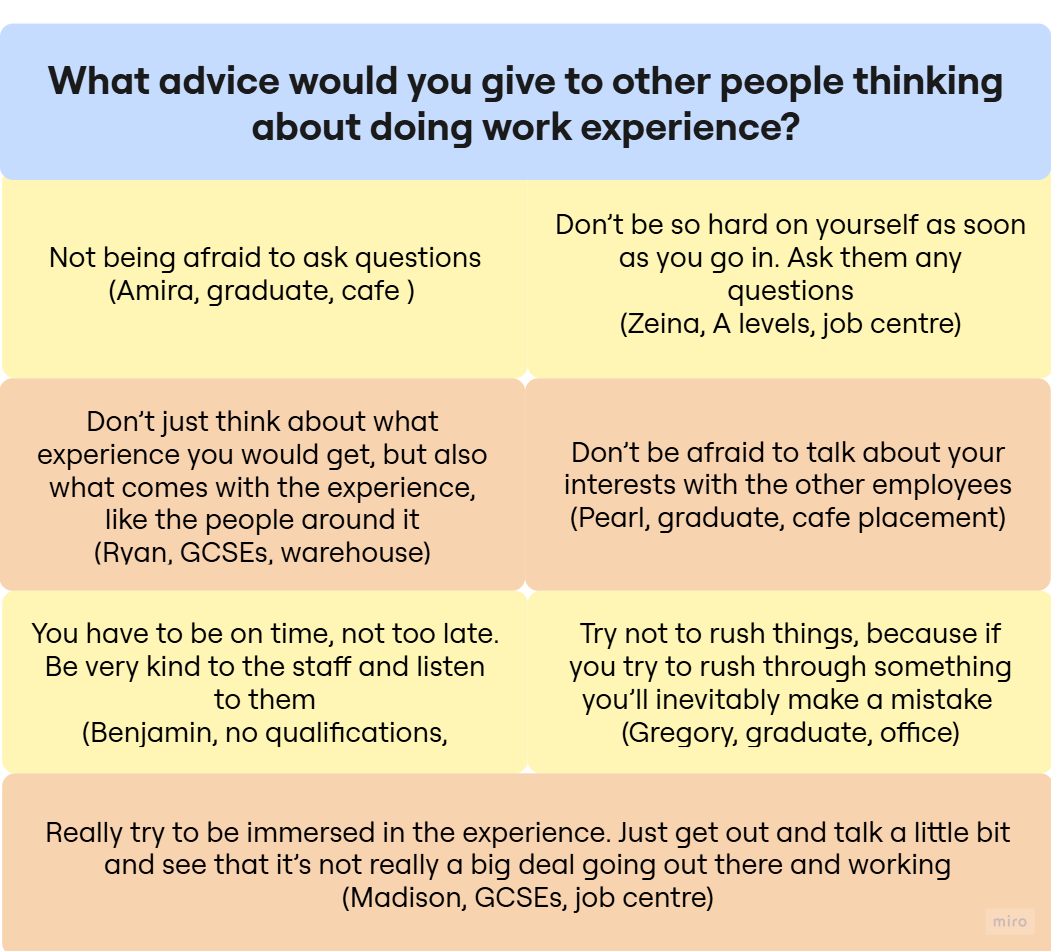
I’m going to end this blog by celebrating the voices of the young people I interviewed, and by passing on the advice they would give to someone considering work experience: Give yourself permission to ask lots of questions, get to know the people you are working with, try to do a good job, and immerse yourself in the experience. As in so many ways, I couldn’t agree with these young people more.