Date: 28/05/2026
Author: Joanna Harlow-Trigg, University of Portsmouth
Bio:
 Joanna Harlow-Trigg is an ESRC SCDTP-funded PhD Researcher within the department of Criminology and Criminal Justice at the University of Portsmouth. Her research explores the design, delivery, and interpretation of community reparation within the youth justice service.
From 13th to 15th April 2026, I had the pleasure of attending the SCDTP Cumberland Lodge residential. On day 1, I was selected to lead a session for my peers from the Citizenship & Security thematic cluster. When the bid was sent out calling for session ideas, I knew immediately the topic I wished to explore. Community.
When I began my PhD 6-months ago, ‘reparation’ was the concept at the forefront of my project. That hasn’t changed, but I hadn’t expected the concept of ‘community’ to become as daunting a challenge as it has. The idea of ‘community’ has reared its everchanging head and firmly planted itself on the frontlines of my conceptual battleground.
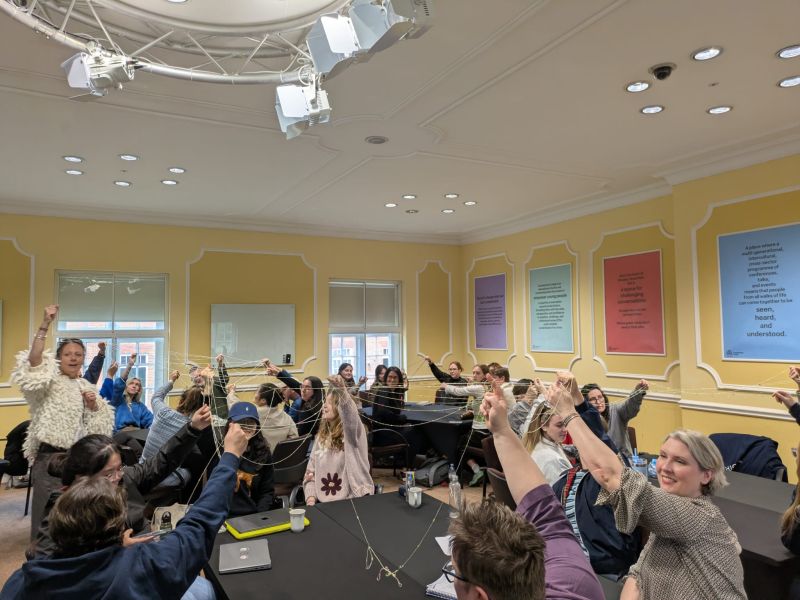
Working within the youth justice service and the wider criminal justice system, the idea of harm to the community, community involvement, and community reintegration are prominent features of theory and policy. The label of ‘community’ – whether it be community-led, community justice, community forum, strengthening community, and so forth – is often heralded as the answer to all challenges faced by systems and spaces. However, these terms are rarely operationalised. Which got me thinking: how do we define community? What makes community? What is the point of community? And so, what better opportunity to wrestle the conceptual titan that I’ve been fighting, than in an arena with a ‘community’ of my peers.
Pause. Time for a thought exercise. Take a second to think about the word ‘community’. What comes to mind?
You’re most likely picturing a group of people. Maybe there’s a sense of warmth and belonging surrounding the group. I hope it’s a happy, harmonious picture. But what brought that group of people together in your mind? Do they all live nearby? Are they simply near one another because their houses were built on the same soil? Are they in this group because they all have something in common? Is it a shared history or a future purpose? Do they have a shared bond, be it through blood or by marriage?
Alternatively, maybe you weren’t picturing a group standing closely together, holding hands, and singing Kumbaya. Maybe, in this glorious age of online space, you were picturing people from all over the world, connected from screen to screen through social media, or WhatsApp, or FaceTime. Now, you’re no longer limited by your surroundings. You can connect with people from every country around the world. If you spend 5 minutes online, you’ll undoubtedly stumble upon someone’s supposed community: BookTok, fandoms, running club, activism groups, a Facebook group for the Neighbourhood Watch, the list goes on. And so, I ask again, what defines a community?
For my session, I was interested in the following prompts:
- Does geography or ideology play a greater role in shaping our communities?
- Does physical community matter less now that online community is so accessible?
- Is community something that must endure, or can it be fleeting? How many of us have bonded with work colleagues, relied on them to get you through the weeks and years, and then never spoken again once we leave the job? When I go to spin class, 15 of us are all working towards the same purpose and peddling towards the same stationary finish line. We’re all furiously peddling our feet in rhythm, we’re all following the same instructions, we’re all desperately trying to survive until the end. This aligns with most definitions – but would you call it community? Even for 45 minutes?
- Are you part of a community simply by virtue of possessing a certain characteristic or does it require active participation and/or identification? Am I in a community with women simply because I am a woman or because I actively choose to align myself with the brilliance, and the battles, of women?
Don’t worry, I haven’t forgotten what this blog is really about. The Cumberland Lodge residential trip. So, I want to contextualise our thought experiment. Spoiler: whilst being at the Cumberland Lodge residential trip, I did feel like I was part of a community, and you would too if you attended. But what was it that made me feel this way?
When Monday morning came and it was time to drive to Windsor, I’ll admit, I was nervous. As a self-proclaimed extroverted-introvert, the thought of ‘networking’ for 2 days straight sounded daunting. I knew there would be a few familiar faces, but a lot of new ones too. However, as soon as I arrived, the sun was shining, the faces were smiling, and the energy was fizzing. I was greeted by Cumberland Lodge employees, the SCDTP staffing team, and fellow SCDTP researchers. I was welcomed with open arms.
For our first activity, our icebreaker, we were mixed-up onto unfamiliar tables. We were given a ball of yarn and told to begin speaking about ourselves. Whenever someone else on the table resonated with something that the person speaking mentioned, they were told to shout “link” and take the yarn, thus forming a visual network of our connections. What felt pertinent was that the task wasn’t about balancing our differences against our similarities. This wasn’t a zero-sum game. Our differences were not weighted negatively, but our similarities were weighted positively. We were there to focus on our commonalities. We didn’t wind the yarn back up whenever someone said something that didn’t connect to anyone else, we kept talking until we found something that aligned. Is this what community is? Pushing through until something connects us?
The theme for this year’s residential was researcher wellbeing. We were there to learn about how to keep happy, healthy, and hardworking throughout this PhD journey and into our future careers. We were learning how to coach ourselves and others through self-doubt. We were also learning how to support others and how to ask for help when we needed it. By all accounts, we were embodying the very essence of a community of care. It wouldn’t be a stretch to say that it was this conceptualisation of community that resonated most for me throughout the trip.
Each day, we were spoilt with a generous amount of food for breakfast, lunch, afternoon cake, and dinner. We were also spoilt with a generous amount of time to enjoy these breaks. This very act of eating together is known as commensality, which is an important cross-cultural practice of social communion and reciprocal cooperation (there was a reason many of our parents told us to eat at the dinner table “like a family”). It was a time to reflect on the day’s sessions, to learn from one another, and to connect beyond our shared identity as SCDTP researchers. We all have to eat to survive – but is it the shared goal of eating or the practice of sharing space that connected us? Was it simply about being present in a shared moment? Or was it that food and space provided opportunity for lively discussions to be had – and that these discussions, these opportunities to create shared histories (no matter how short-lived), evidenced community in action? I left every meal with a full belly, a full head, and a full heart; so, whatever it was, it worked.
On day 2, I finally collected my SCDTP hoodie (I know, I’m surprised it wasn’t the first thing I searched for). From here on, I now shared a uniform with my peers. As we moved through the day’s sessions, we formed a visual collective. Was this what brought us together? Is this what bonds police officers, or Parkrun volunteers, or nurses? Is an ID badge just a matter of security or is it a way of demonstrating that a group of people are supposedly all operating under shared organisational values?
Everyone has their own idea of the ‘stereotypical’ PhD researcher. But looking around the room at Cumberland Lodge, hearing the lived experiences and interests of the people there, discussing everyone’s different approaches to work, sharing our varying goals and aspirations, I would challenge anyone to try and reduce that variety into one all-encompassing representation of a ‘PhD community’. And so, does the word ‘community’ obscure important nuances or is this the exact point? Is it our differences or our similarities that make us? Or is it a complicated structure of all the above and everything in between?
Maybe there is no clear selection criteria for what creates, maintains, or breaks community. Maybe your picture of community may look very different to mine. What the Cumberland Lodge residential did was give us the best chance of fulfilling everyone’s unique criteria of community. We shared space. We shared purpose. We shared histories and we shared future goals. We discussed our failures and our successes. We expressed care for others and practiced care for ourselves. And so, I may still not know how to perfectly define ‘community’, but I certainly caught a snippet of what community should be at this year’s Cumberland Lodge residential.