Kezia Pugh and Carolynn Low, both researchers with the ESRC South Coast Doctoral Training Partnership (SCDTP), have each published a policy brief on fair work. Kezia's is about protecting migrant care workers from exploitation. Carolynn's is about helping newly arrived refugees into work that suits their skills.
The two briefs cover different ground, but they share a question: what gets in the way of decent work? For the migrant care workers Kezia writes about, it is a visa that ties someone's right to stay in the UK to a single employer. For the refugees Carolynn studied, it is a labour market that too often overlooks what they already know how to do.
Care work and the right to speak up
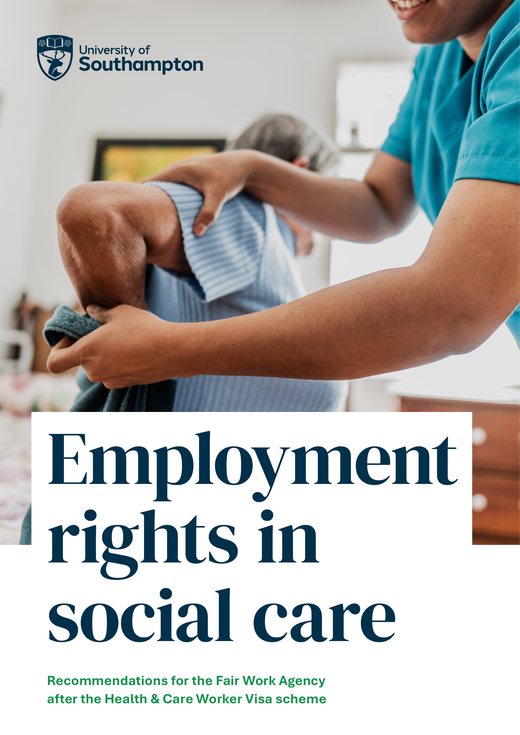
Almost 200,000 care workers came to the UK between 2021 and 2025 on the Health & Care Worker Visa, and reports of wage theft and debt linked to illegal recruitment fees followed. Kezia's brief, Employment Rights in Social Care: Recommendations for the Fair Work Agency after the Health & Care Worker Visa Scheme, draws on interviews with policymakers, trade unions and migrants' rights campaigners to ask how exploitation spread so widely.
Her answer is structural. Workers were tied to their sponsoring employer, and anyone who lost a job had 60 days to find a new sponsor or risk their legal status. That made it hard to move on, and harder still to report abuse.
She recommends, among other things, a firewall between labour market enforcement and immigration enforcement so that workers can report abuse safely, clear guidance on employment rights shared through trade unions and community organisations, and a Certificate of Common Sponsorship that would let care workers move between employers. The recommendations are aimed at policymakers and the Fair Work Agency, newly established under the Employment Rights Act.
Refugees, skills and the road to work
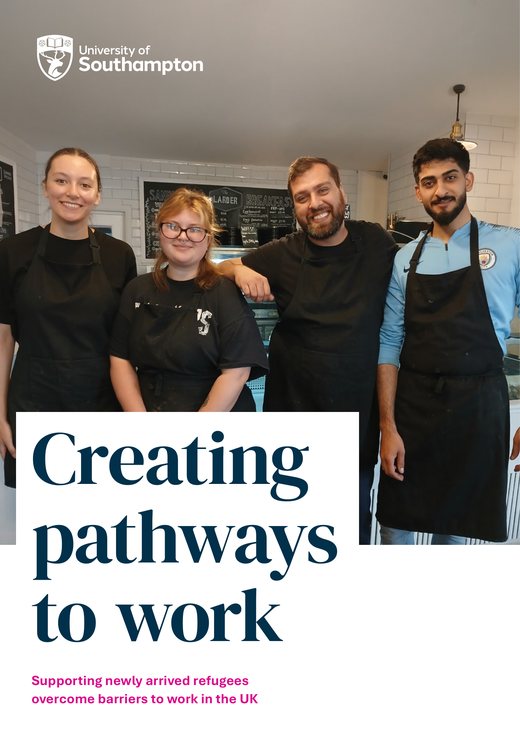
Carolynn's brief, Creating Pathways to Work: Supporting Newly Arrived Refugees Overcome Barriers to Work in the UK, draws on an evaluation of Oxford's Refugee Employment Support Programme, which Oxford City Council funded. Between June 2023 and August 2024 the programme supported 22 refugees with tailored help on English, mentoring, training and job applications.
Interviews with participants and service providers pointed to barriers that many refugees and other migrants face: unfamiliar rules, limited English, complicated applications and qualifications that employers do not recognise, alongside childcare and the wider demands of settling in.
The brief's answer is support that is personal and lasts: individual plans, regular one-to-one mentoring from trained volunteers, English teaching tailored to work, and help towards jobs that match people's skills rather than insecure, entry-level roles alone. One participant, Ali, arrived keen to work but held back by limited English. After weekly lessons, mentoring and substantial help with applications, he secured his first paid job in the UK.
Evidence for policy and practice
Neither brief claims the last word. Each sets out evidence and specific recommendations for the people best placed to act on them: policymakers and the Fair Work Agency in Kezia's case, employment programmes, employers and Jobcentres in Carolynn's. Whether they are taken up is for those audiences to decide. At four and six pages, the briefs are a short way into the evidence for anyone joining those conversations.
Congratulations to Kezia and Carolynn. Both briefs are linked below.
Read the policy briefs
-
Employment Rights in Social Care: Recommendations for the Fair Work Agency after the Health & Care Worker Visa Scheme
Kezia Pugh, ESRC SCDTP researcher
Why the Health & Care Worker Visa left migrant care workers open to exploitation, and what the Fair Work Agency could do about it.
PDF, 4 pages
-
Creating Pathways to Work: Supporting Newly Arrived Refugees Overcome Barriers to Work in the UK
Carolynn Low, ESRC SCDTP researcher
What helped 22 refugees in Oxford move towards work, and what employment support can take from it.
PDF, 6 pages
Both briefs were supported by the University of Southampton's Work Futures Research Centre, with input from Public Policy Southampton. Kezia and Carolynn's PhD research is supported by the ESRC SCDTP, and Carolynn's brief was also commissioned by Oxford City Council.